Why New Entrepreneurs Overcomplicate Their Sales Funnel

A sales funnel is supposed to make selling easier. But for a lot of new entrepreneurs, it somehow becomes one of the first things they turn into a small engineering project. Before long, instead of actually trying to sell something, you're building pages, automations, email sequences, tags, and all kinds of stuff you don't even know if you need yet.
You sit down to sell one offer, and twenty minutes later you're comparing webinar software, naming seven email tags, and wondering whether you need a downsell for the upsell you haven't even built yet. Somehow, the funnel stops helping you sell and becomes the entire project.
And look, I get it. I can overthink this stuff too. A complicated setup can make you feel like you're doing serious business-building work because you're creating pages, connecting software, setting up automations, and moving things around. There's always something else you can tweak.
Meanwhile, there's usually a much less comfortable question sitting underneath all of it: Will anyone actually buy this?
Sometimes, it's sophisticated procrastination. 🙋♂️ Guilty.
The problem isn't that you're ambitious or that you're thinking ahead. The problem is usually the order you're doing things in. A new business needs evidence before it needs a bunch of infrastructure. You need to learn who actually wants the offer, what gets their attention, what makes them hesitate, and what they need to hear before they're comfortable taking the next step.
If you build too much before you know those things, you don't necessarily get more sales. You mostly get more places to feel confused when something isn't working.
A simple sales funnel gives you something a lot more useful: a clear path you can actually launch, watch, learn from, and improve.
Sales Funnels Are a Path
Not a Pile of Software
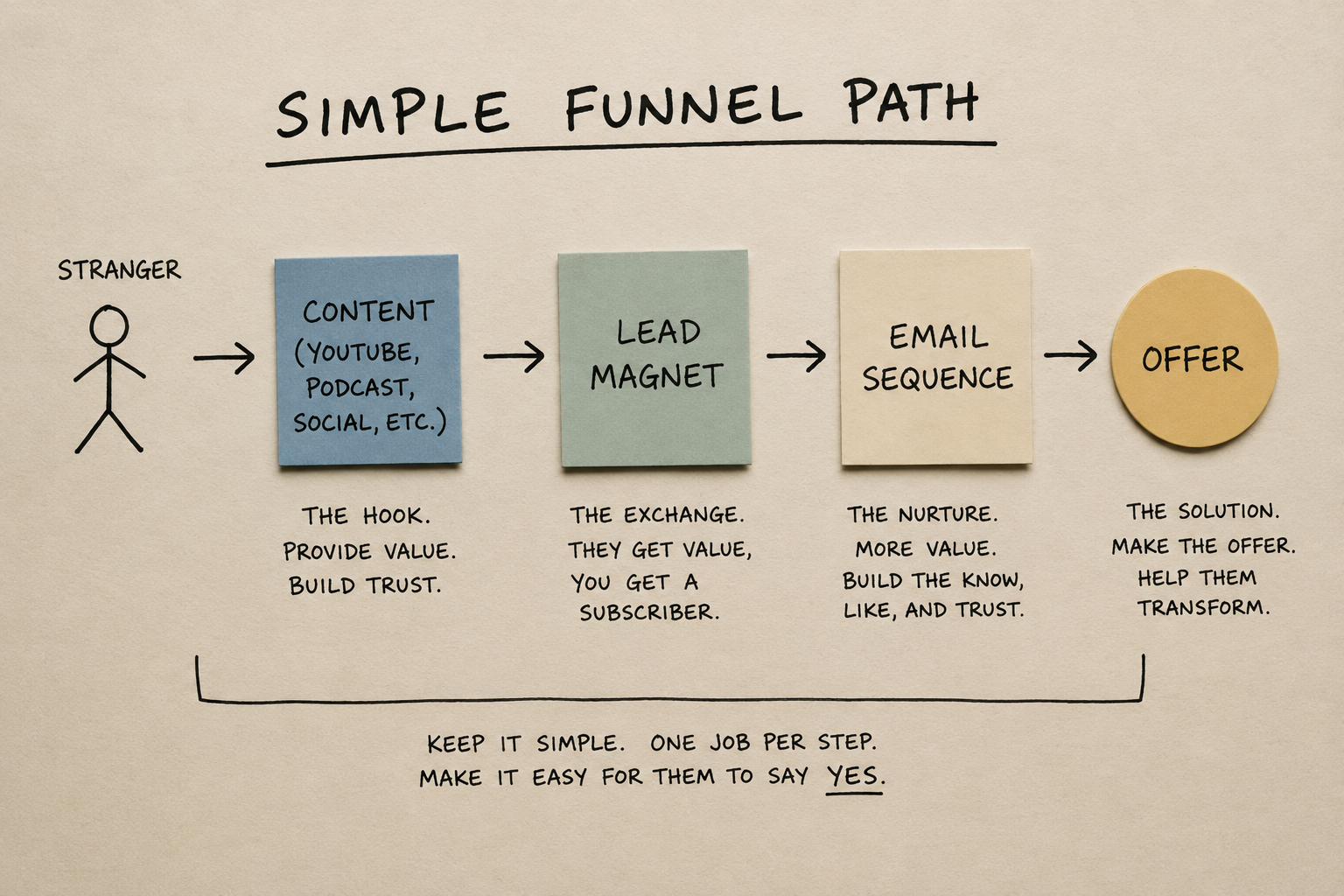
At its core, a sales funnel is just the path someone takes from finding you to eventually becoming a customer. I actually prefer thinking about it as a customer journey, because that's really what it is.
For a small online business, that journey can be incredibly simple:
Attention → relevant offer → one clear action → follow-up → sale
Someone finds one of your articles, watches a video, sees a post, hears about you from somebody else, or lands on your site. They find something that speaks to a problem they're already trying to solve, and then they decide what they want to do next.
Maybe they buy. Maybe they book a call. Maybe they join your email list because they're interested but they're not ready yet. Then you help them figure out what the next logical step is.
That's a funnel. No dramatic reveal and no giant wall-sized automation map required.
People aren't always going to move through it in a perfectly straight line either. They'll look around, leave, compare things, watch a few more videos, forget about you for three weeks, and then randomly remember something you said and come back.
You can't control every step somebody takes before they buy, and honestly, you don't need to. Your job is just to make the next step clear when they're ready to take it.
They Copy a Finished Business
This is one of the easiest traps to fall into. You find somebody who's already successful, look at their funnel, and think, okay, I guess I need all of that too.
The problem is that you're looking at version 27 of their business and trying to make it version one of yours. They may have multiple audiences, several offers, years of conversion data, paid ads running, a whole email system, and maybe even a team managing half of it.
You probably don't need to copy all of that yet.
That's kind of like using the floor plan for a hotel because you're trying to build a one-bedroom house. More rooms don't automatically make the house better. Now you just have more rooms to clean.
Build for the business you actually have right now. You can always add another wing later.
They Choose the Software Before Defining the Sale
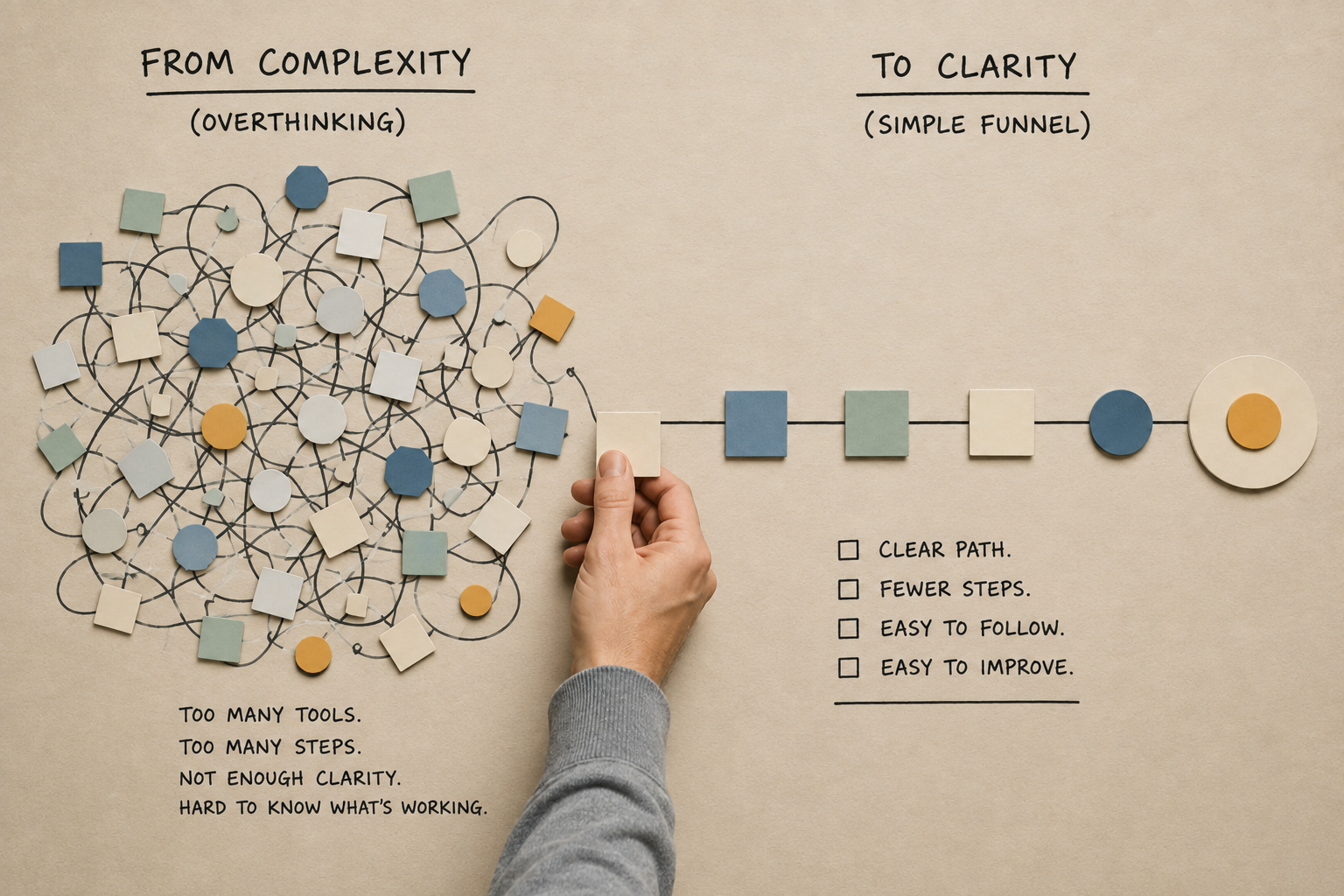
Funnel software is really good at showing you everything you could possibly build. Quizzes, webinars, challenges, order bumps, upsells, downsells, lead scoring, behavioral triggers, abandoned-cart emails. Give yourself five minutes looking at all the features and suddenly you can feel behind before you've even started.
At some point, you have to stop and ask: What the freak are we even building?
All of those features can be useful, but they're not the strategy. If you can't explain what you're selling and what you want somebody to do next in plain English, adding another integration probably isn't going to fix anything. It'll just automate the confusion.
Before you touch the software, answer these four questions:
- Who is this for?
- What problem are they trying to solve?
- What am I actually offering them?
- What do I want them to do next?
Once you know those answers, then the software can help you build the path. Don't let the software decide what the path is supposed to be.
They Automate a Process They Haven't Learned Yet
Automation isn't the problem. Automating something before you've figured out what actually works is the problem.
Automation is amazing when it's removing repetition from a process you already understand, but a lot of new entrepreneurs try to do it backwards. They want to automate the sales conversation before they've had enough sales conversations to know what people are actually asking.
Those early emails, replies, DMs, calls, objections, and weird questions people ask you are incredibly useful. They show you where your message is confusing, what people actually care about, what probably belongs on your sales page, and what questions need to be answered in your follow-up emails.
Don't automate a mystery. You might save yourself some time, but you're really just doing the wrong thing faster.
Complexity Feels Safer Than Asking for the Sale
This one is probably more psychological than technical. Building systems feels productive because it's private. Nobody can reject your automation rule, and nobody can say no to the email sequence you're still rewriting for the sixth time.
Making the actual offer is different. Somebody can ignore it, question it, or simply say no. So sometimes it's easier to keep building instead. One more email, one more bonus, one more redesign, one more thing you have to “finish” before you're finally ready.
If that sounds like you, go listen to my episode about why you should start messy . I talk a lot more about that there.
Most of the time, the fastest way to get clarity isn't to keep planning. It's to put the offer in front of the right people and see what happens.
They Try to Serve Everybody
Funnels also get complicated really fast when you're trying to make one page work for everybody. Beginners and advanced customers don't have the same questions. A course creator and a consultant may want completely different things. Somebody shopping for a $27 product is probably thinking differently than somebody considering a $5,000 service.
When you try to speak to all of them at once, you end up adding more copy, more choices, more branches, and usually a lot less clarity.
Your first funnel does not have to represent every single thing your business might become someday. It just needs to help one kind of person solve one meaningful problem.
The Hidden Cost of
an Overbuilt Funnel
The obvious problem with an overbuilt funnel is that it takes forever to launch. But there's another problem I think is even worse: it becomes much harder to tell what isn't working.
If you have five landing pages, three offers, multiple traffic sources, a webinar, twelve emails, and six automations running at once, where exactly did things go wrong?
Was it the audience? Was the offer confusing? Did the page not make sense? Did somebody never get the email? Did the checkout break? Or did nobody actually want what you were selling?
Every extra moving part gives you one more possible reason something isn't working, and then you have to maintain all of it too. Pages get outdated, links break, offers change, automations start conflicting with each other, and software subscriptions keep showing up on your credit card.
The system that was supposed to create more freedom can very quickly become another job.
Your customer feels that complexity too. Too many choices, too much information, and too many competing calls to action make it harder to know what to do.
Your job isn't to answer every possible question somebody could ever have. It's to make the decision in front of them easier to understand.
Simple doesn't mean shallow. It means focused.
What a Simple Sales Funnel
Actually Needs
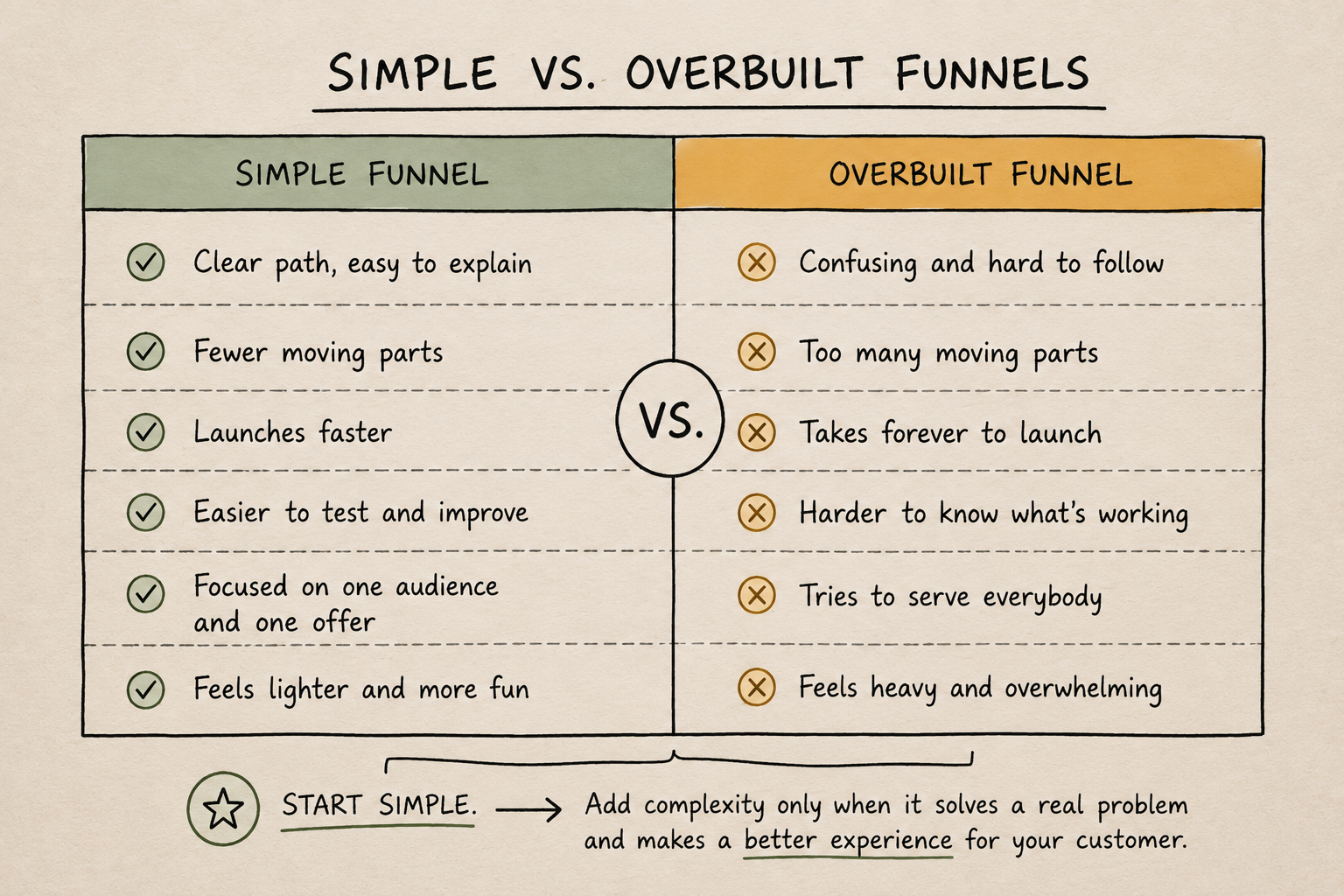
You really don't need that much to get started. For most beginners, a useful funnel comes down to six basic things.
1. One Specific Audience
Pick the person whose problem you understand best. “New course creators who have an idea but can't figure out how to organize their first course” gives you something useful to work with. “Anybody who wants to make money online” really doesn't.
When you know who you're talking to, everything gets easier. Your examples get easier, your promise gets easier, your sales page gets easier, and even figuring out what objections to answer gets easier.
2. One Core Offer
Your content, lead magnet, emails, and sales page should all be moving somebody toward the same general outcome. If your free resource solves one problem and then your paid offer suddenly jumps to something completely different, people may join your list and never buy anything.
They may not have lost interest. You may have simply changed the subject on them.
Figure out the paid offer first, then build the shortest useful bridge that helps somebody get there.
3. One Primary Source of Attention
You do not need to master SEO, YouTube, Instagram, webinars, partnerships, Facebook ads, TikTok, Pinterest, and whatever new platform showed up this morning.
Pick one place you can show up consistently and where your audience actually looks for help. Learn what gets their attention, what questions they ask, and what makes the right people click. Once you understand that, you can always expand later.
4. One Clear Action
Decide what you're actually asking somebody to do.
- Buy the product.
- Book a call.
- Join your email list if they need more time before buying.
You can still have navigation, answer questions, and give somebody other things to explore, but one next step should feel more obvious than everything else.
5. One Useful Follow-Up Sequence
Follow-up does not mean you need 30 emails with twelve different branches and a diagram that looks like an airport map.
Start with what a real person actually needs. Give them the thing they asked for, help them use it, answer one of the biggest questions they probably still have, explain your offer, and ask them to take the next step. Heck, invite them to reply to the email.
Later, if you notice different groups of people really do need different follow-up, then you can start adding segmentation. You don't have to predict every possible customer journey before you even have customers.
6. A Few Measurements You Can Actually Use
You don't need to track 47 numbers just because your dashboard lets you. Start with the numbers that actually help you make a decision.
- How many relevant people reached the page?
- How many took the main action?
- How many actually became customers?
Depending on what you're selling, you might also care about email clicks, booked calls, show-up rates, or how many people made it through checkout. But don't track something just because it looks impressive on a dashboard.
If the number doesn't help you make a decision, you probably don't need to obsess over it yet.
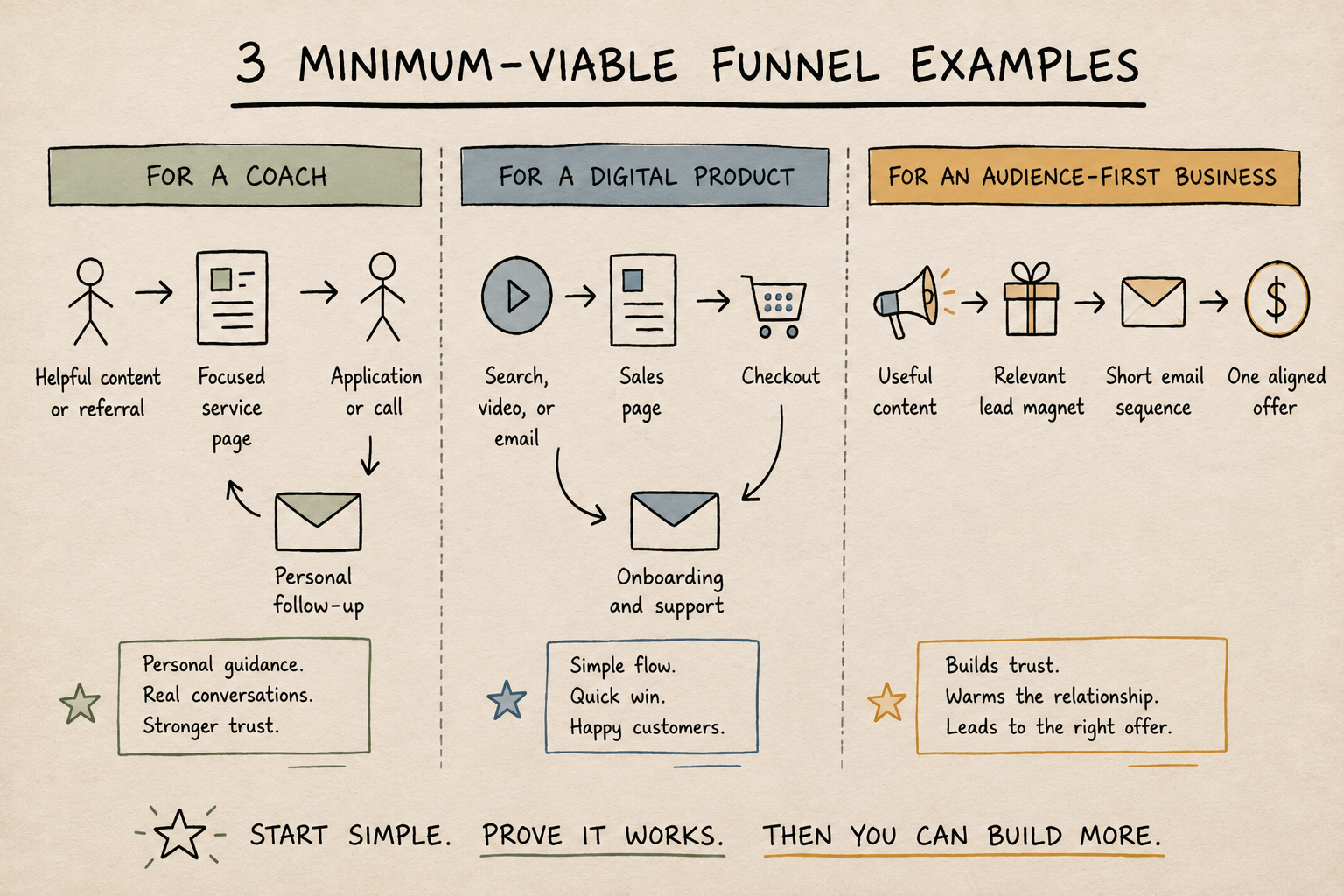
Your funnel is going to look a little different depending on what you sell, but none of these needs to be complicated.
For a coach: Helpful content or a referral → focused service page → application or call → personal follow-up.
For a course or digital product: Search, video, or email → sales page → checkout → onboarding and support.
For an audience-first business: Useful content → relevant lead magnet → short email sequence → one aligned offer.
Notice what's missing? A bunch of random detours that don't have a reason to exist yet.
You can always add a webinar, quiz, tripwire, upsell, retargeting campaign, or whatever else later. Just add it because it solves a problem you can actually see, not because somebody on YouTube told you a “real” funnel is supposed to have one.
Add Complexity Only When
It Has Earned a Job
Complexity isn't always bad. Premature complexity is.
Add another step when you can explain exactly why it's there and what problem it's solving. For example:
- You have two proven audiences that really do respond to different messages.
- You're getting enough leads that you can't realistically follow up with everybody manually anymore.
- Customers keep asking for the same related product or service.
- You can clearly see people dropping off because they need more information or reassurance.
- One traffic source behaves differently enough that giving it its own page actually makes sense.
And when you can, change one thing at a time. If you rewrite your whole sales page, change your offer, add a webinar, and replace your email sequence all in the same week, you might improve something, but you won't know what actually caused the improvement.
The goal isn't to keep your funnel tiny forever. The goal is to keep understanding what your own system is doing as it grows.
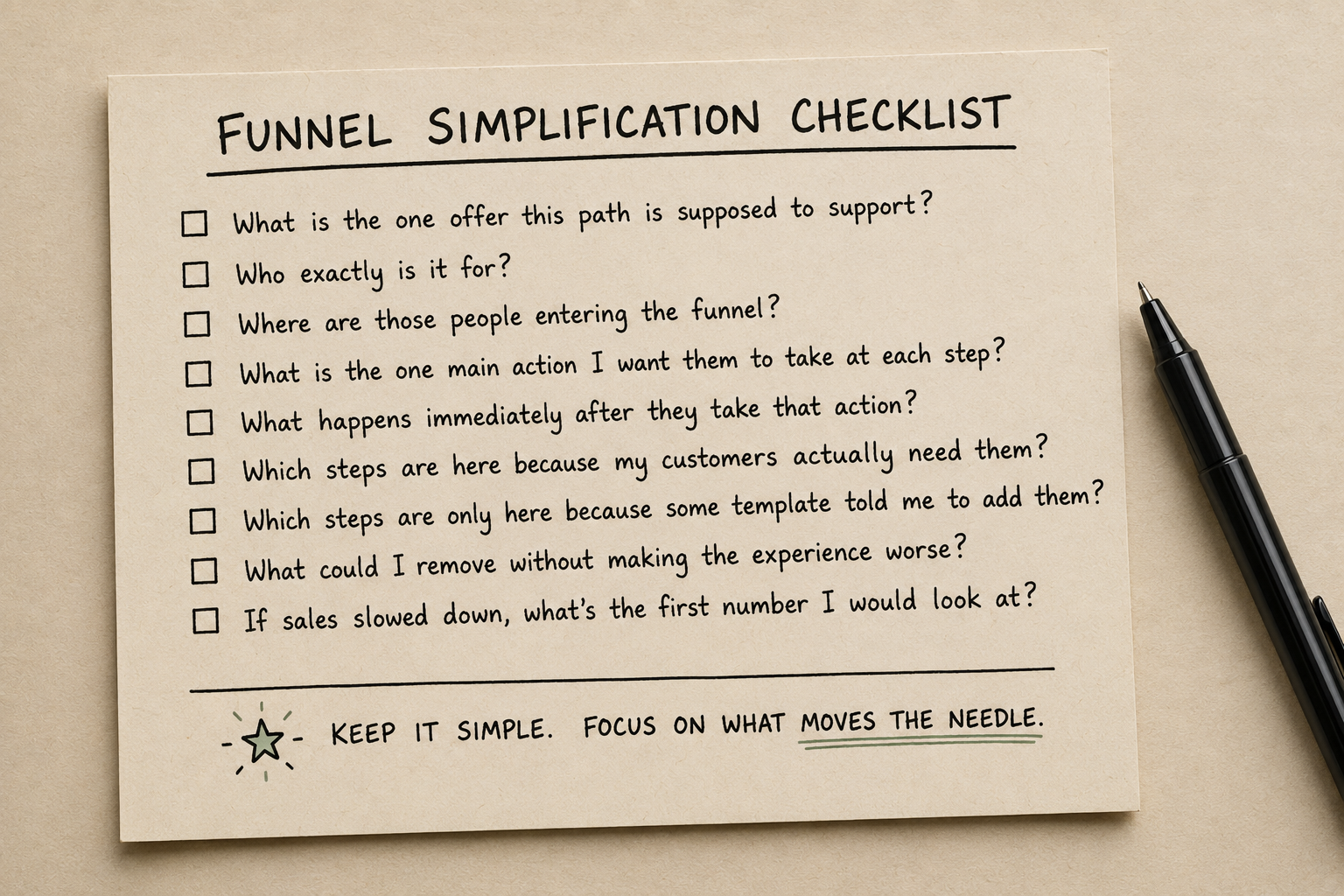
If your funnel already feels like it's gotten a little out of control, grab one sheet of paper and draw the whole thing out. Then ask yourself:
- What is the one offer this path is supposed to support?
- Who exactly is it for?
- Where are those people entering the funnel?
- What is the one main action I want them to take at each step?
- What happens immediately after they take that action?
- Which steps are here because my customers actually need them?
- Which steps are only here because some template told me to add them?
- What could I remove without making the experience worse for the customer?
- If sales suddenly slowed down, what's the first number I would actually look at?
If you can't answer those questions without opening a giant diagram and staring at it for twenty minutes, I probably wouldn't add anything else yet. Simplify it until you can explain the whole path to somebody else without getting lost halfway through.
Build the Funnel You Can Learn From
Your first funnel does not need to impress another marketer. It needs to help the right person figure out what to do next.
Start with the shortest useful path you can build, put real people through it, and pay attention to where they get confused or drop off. Fix the obvious stuff first, and then start automating the parts that keep repeating.
That's how a simple sales funnel starts becoming an actual business system instead of another job you accidentally created for yourself.
Ready for a Clearer Starting Point?
If you're still trying to figure out how to turn what you already know into something you can actually sell online, download my free 30-Day Freedom Formula .
It'll walk you through a much simpler starting point for turning your knowledge or experience into an online income stream without feeling like you need a huge audience or a giant tech setup first.